Market Insights for Petroleum Jelly Buyers and Grade Selection
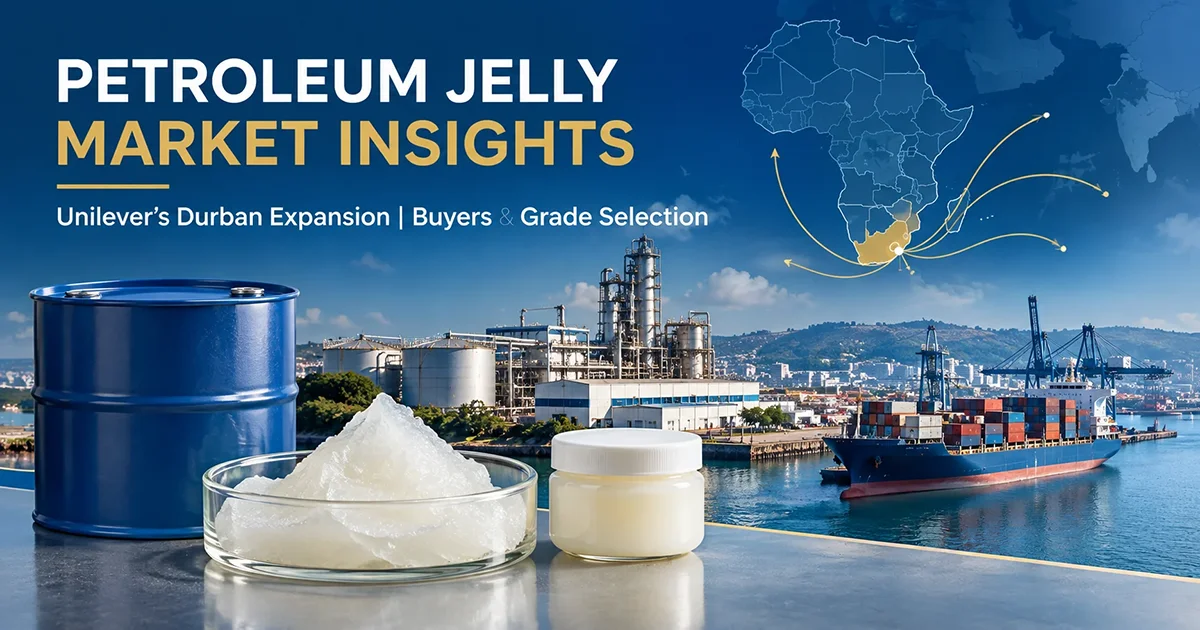
On 2 October 2026, Unilever South Africa commissioned an additional Vaseline Petroleum Jelly production line at its Maydon Wharf facility in Durban after an incremental investment of R100 million (approximately US$6 million).
(Unilever’s R100 million investment in Durban)
Unilever’s Durban Expansion
The expansion is expected to lift the site’s share of Unilever’s global Vaseline Petroleum Jelly volume from about 60 percent to 80 percent.
For industrial buyers, importers, and manufacturers who source petroleum jelly in bulk, the development underscores two practical realities: production can become highly concentrated, and finished consumer products are not automatically interchangeable with industrial, cosmetic, or pharmaceutical grades.
For petroleum jelly buyers, the Durban expansion highlights the importance of understanding product grades, intended applications, and supplier capabilities.
Whether sourcing industrial petroleum jelly for manufacturing or higher-purity grades for personal-care applications, buyers should confirm technical specifications, quality documentation, and delivery requirements before placing bulk orders.
Executive Summary
- Unilever’s Maydon Wharf plant in Durban is positioned to supply roughly four-fifths of the company’s global Vaseline Petroleum Jelly volume after the new line.
- The investment adds packing capacity, process equipment, and bulk storage at an existing manufacturing site that already serves African and international markets.
- Petroleum jelly grades differ by purity, color, intended application, and regulatory requirements; industrial material is not automatically suitable for cosmetic or pharmaceutical use.
- Buyers should verify oil content or related purity indicators, color, melting or congealing characteristics, and full documentation before purchase.
- Concentrated finished-product manufacturing does not eliminate the need for independent industrial-grade supply chains and specification matching.
What Was Announced and Where
Unilever’s official announcement confirms the commissioning of a new production line at the historic Maydon Wharf facility. The R100 million investment supports additional packing capacity (described in secondary reporting as a fourth packing line), processing equipment, and bulk storage.
Company statements and contemporaneous reporting indicate the site previously accounted for approximately 60 percent of Unilever’s worldwide Vaseline Petroleum Jelly volume; the expansion is projected to raise that share to about 80 percent. Local sourcing of materials by Unilever in South Africa has also risen substantially in recent years, according to company comments.
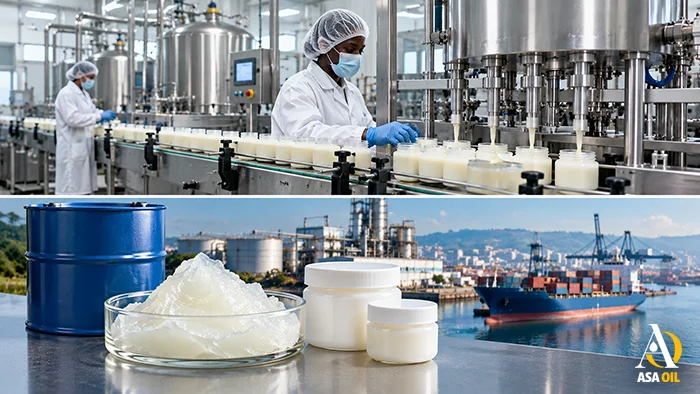
The facility employs several hundred full-time and freelance staff and functions as both a regional and export-oriented manufacturing hub. The development is therefore a finished-product capacity increase for a well-known consumer brand rather than the startup of a new bulk industrial petroleum-jelly refinery.
Why Petroleum Jelly Grade Distinctions Matter
Petroleum jelly (petrolatum) is produced by refining residual petroleum streams. Different grades exist for different end uses:
- Industrial-grade petroleum jelly is typically used in lubricants, rust preventives, battery terminals, rubber compounding, and other technical applications. Color, odor, and purity requirements are generally less stringent than for personal-care uses.
- Cosmetic-grade (often white or yellow) petroleum jelly must meet tighter limits on color, odor, and residual impurities for skin-contact products.
- Pharmaceutical-grade petroleum jelly is subject to pharmacopoeial standards (for example USP, BP, or Ph. Eur. where claimed) covering purity, melting range, and other parameters. Compliance claims require supporting certificates; they cannot be assumed from industrial material.
Key technical parameters that petroleum jelly buyers commonly evaluate include color (visual or instrumental), congealing or melting point, consistency/penetration, and residual oil or related purity indicators. Packaging, storage conditions, and contamination controls during transport also affect fitness for purpose.
Industrial material packaged for technical use should not be represented as suitable for cosmetic or pharmaceutical applications without explicit evidence of the required specifications and regulatory compliance.
The Durban expansion concerns Unilever’s branded finished Vaseline product. It does not, by itself, alter the availability or specifications of bulk industrial petroleum jelly offered by independent refiners and traders.
Regional and Supply-Chain Implications
South Africa’s role as a manufacturing and export platform for finished petroleum-jelly products has increased. For African buyers of finished consumer goods this can shorten some regional supply chains.
For industrial petroleum jelly buyers across Africa, India, and other markets who require bulk petroleum jelly for manufacturing, the concentration of one major consumer brand’s output highlights the value of diversified suppliers of industrial grades.
Import requirements vary. India, for example, classifies petroleum jelly under HS codes that attract specific duties; buyers must confirm current tariff treatment, any quality standards, and labeling rules for their destination.
Packaging in drums, cartons, or bulk containers, along with certificates of analysis and origin, forms part of normal commercial documentation. Landed cost is influenced by freight, insurance, duties, and local handling—factors that differ between West African, East African, and South African ports.
Practical Procurement Considerations
Buyers evaluating petroleum jelly offers can use the following checklist:
- Confirm the intended grade and application (industrial, cosmetic, or pharmaceutical) in writing.
- Request a current certificate of analysis covering the parameters relevant to the application (color, congealing point, consistency, and any purity indicators specified).
- Verify that any regulatory or pharmacopoeial claims are supported by documentation; do not assume compliance.
- Check packaging integrity, labeling, and storage recommendations to prevent contamination or degradation.
- Clarify delivery terms (Incoterms), lead time, and quality inspection options (third-party inspection where appropriate).
- Assess supplier consistency across multiple shipments rather than relying on a single sample.
These steps help reduce the risk of receiving material that does not match formulation or regulatory needs.
Choosing a reliable Petroleum Jelly Supplier
Choosing a reliable Petroleum Jelly Supplier involves more than comparing prices. Buyers should assess grade consistency, certificate of analysis, packaging options, export experience, and the supplier’s ability to meet destination-specific requirements. These checks are particularly important for international buyers purchasing petroleum jelly in bulk for industrial or manufacturing applications.
What to Watch Next
Further details on actual output volumes or export statistics from the expanded Durban line may appear in company updates or trade data. Buyers of industrial grades can continue to monitor regional refinery wax and residual-stream availability, as these influence bulk petroleum-jelly supply.
Any new pharmacopoeial or regional quality standards affecting petroleum jelly would also be relevant for compliance-sensitive applications.
Frequently Asked Questions
Is industrial petroleum jelly the same as the Vaseline product made in Durban?
No. The Durban expansion produces Unilever’s finished consumer Vaseline Petroleum Jelly. Industrial petroleum jelly is a separate commercial grade with different purity and application requirements. The two should not be treated as interchangeable.
Can industrial-grade petroleum jelly be used in cosmetics or pharmaceuticals?
Only if it has been specifically refined, tested, and documented to meet the relevant cosmetic or pharmacopoeial standards. Industrial material is not automatically suitable. Always require supporting certificates for the intended use.
What documentation should accompany a petroleum jelly shipment?
Typical documents include a certificate of analysis, packing list, bill of lading or airway bill, certificate of origin, and any quality-inspection report. For regulated applications, additional compliance documentation may be required.
Does the Durban expansion affect bulk industrial petroleum jelly availability?
The announcement concerns finished consumer-product capacity. Independent industrial-grade supply continues to depend on refinery residual streams, wax processing, and trade flows. Buyers should evaluate specific industrial offers on their own specifications.
Conclusion
Unilever’s verified capacity increase at Maydon Wharf concentrates a large share of one major consumer petroleum-jelly brand in South Africa. For industrial buyers and importers the more immediate value lies in the reminder that petroleum jelly grades are application-specific.
Clear specification matching, proper documentation, and recognition that finished consumer products differ from bulk industrial material remain the practical requirements for reliable procurement. Readers who need to discuss industrial petroleum jelly grades, quantities, or destination requirements can contact ASA Oil through the website inquiry channels.